Newsletter

Join our mailing list for latest news and features

Build Hollywood

Build Hollywood

Build Hollywood

Build Hollywood

Your Space Or Mine

Look a Little Longer with Fiona Quadri

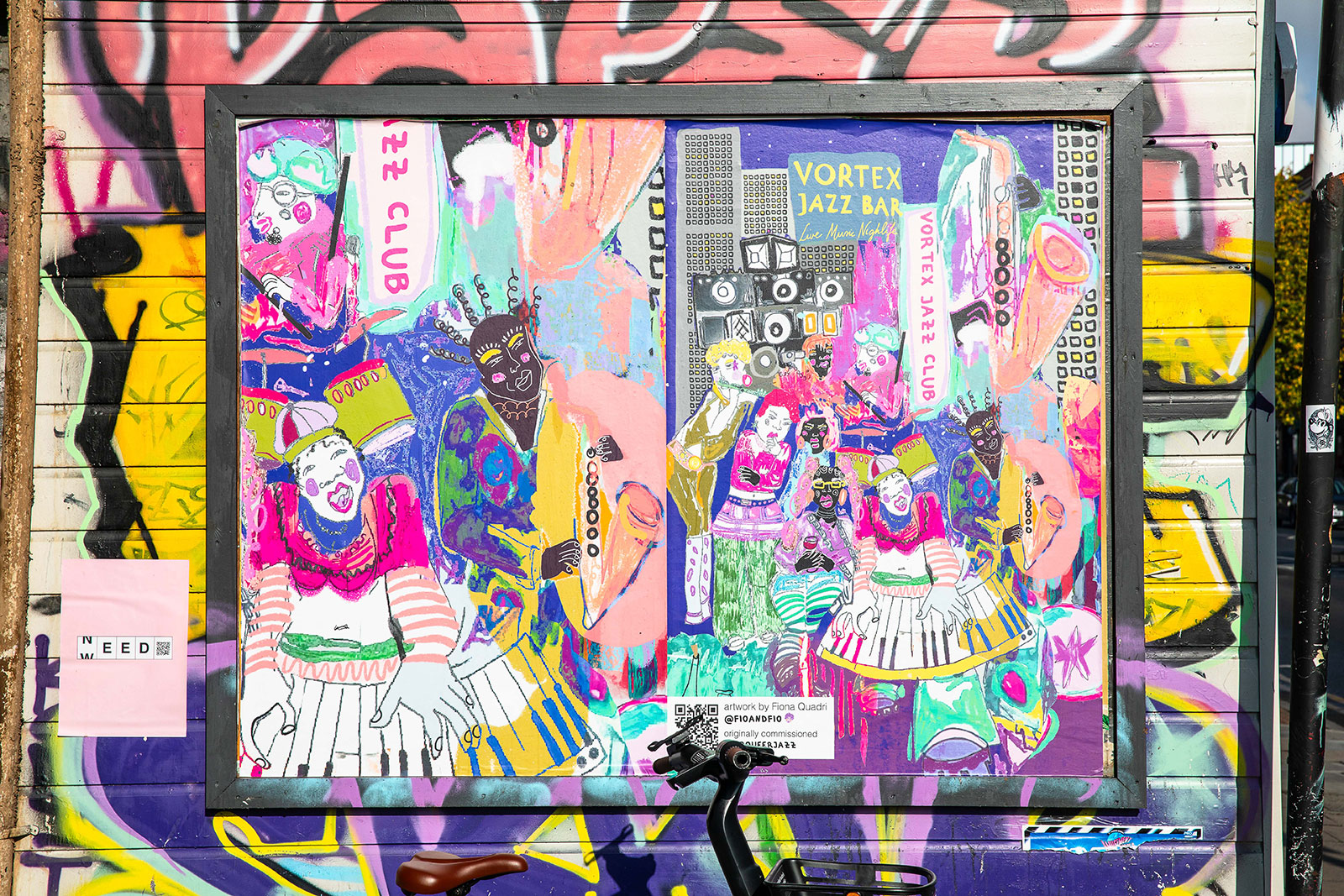
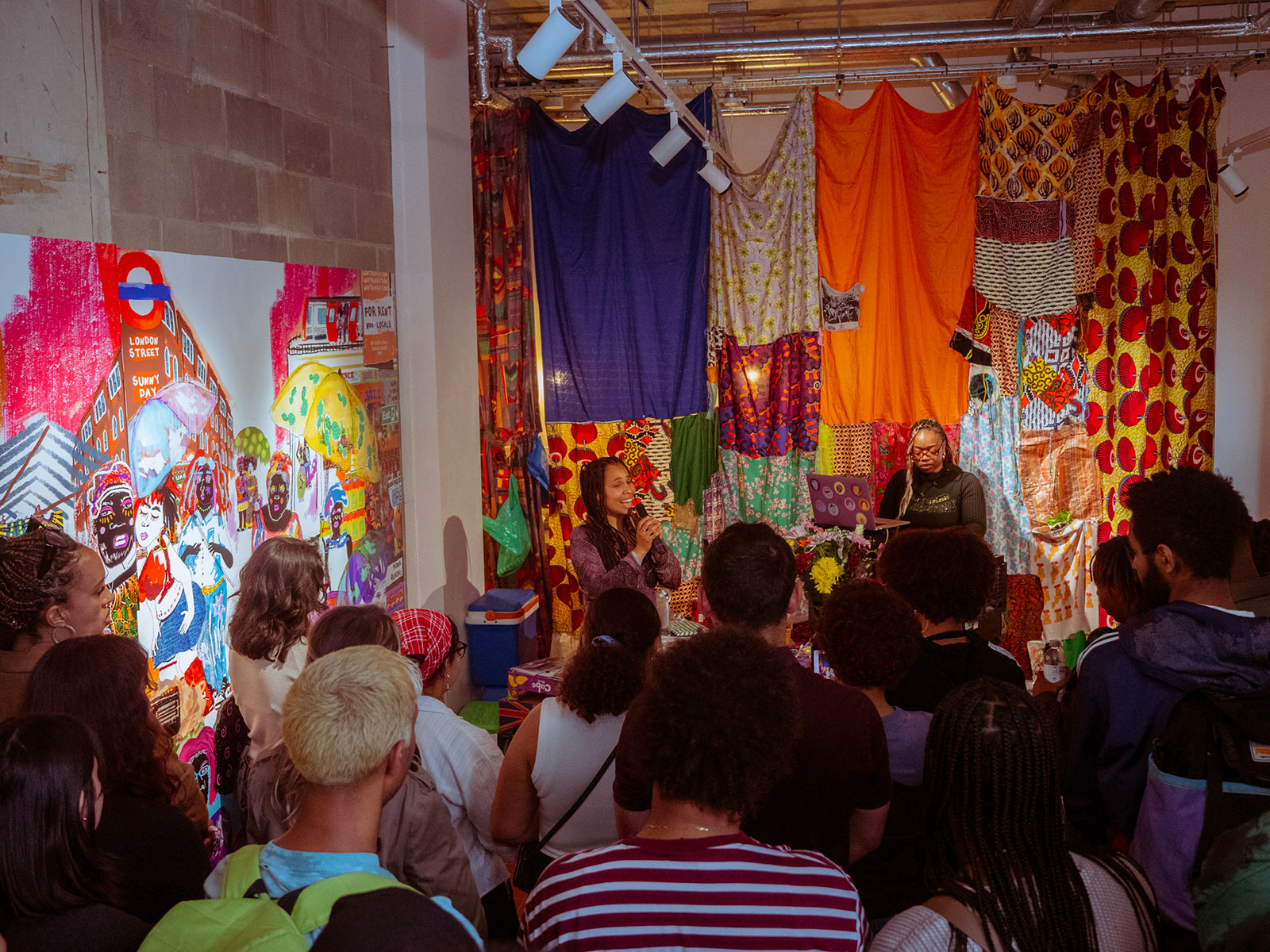
From Indomie-stacked living rooms to the view from the top deck of a double-decker, Fiona Quadri finds whole worlds in the everyday. For her latest project Abundance of Being, the London-based artist is giving those everyday worlds space across the city that inspired them.

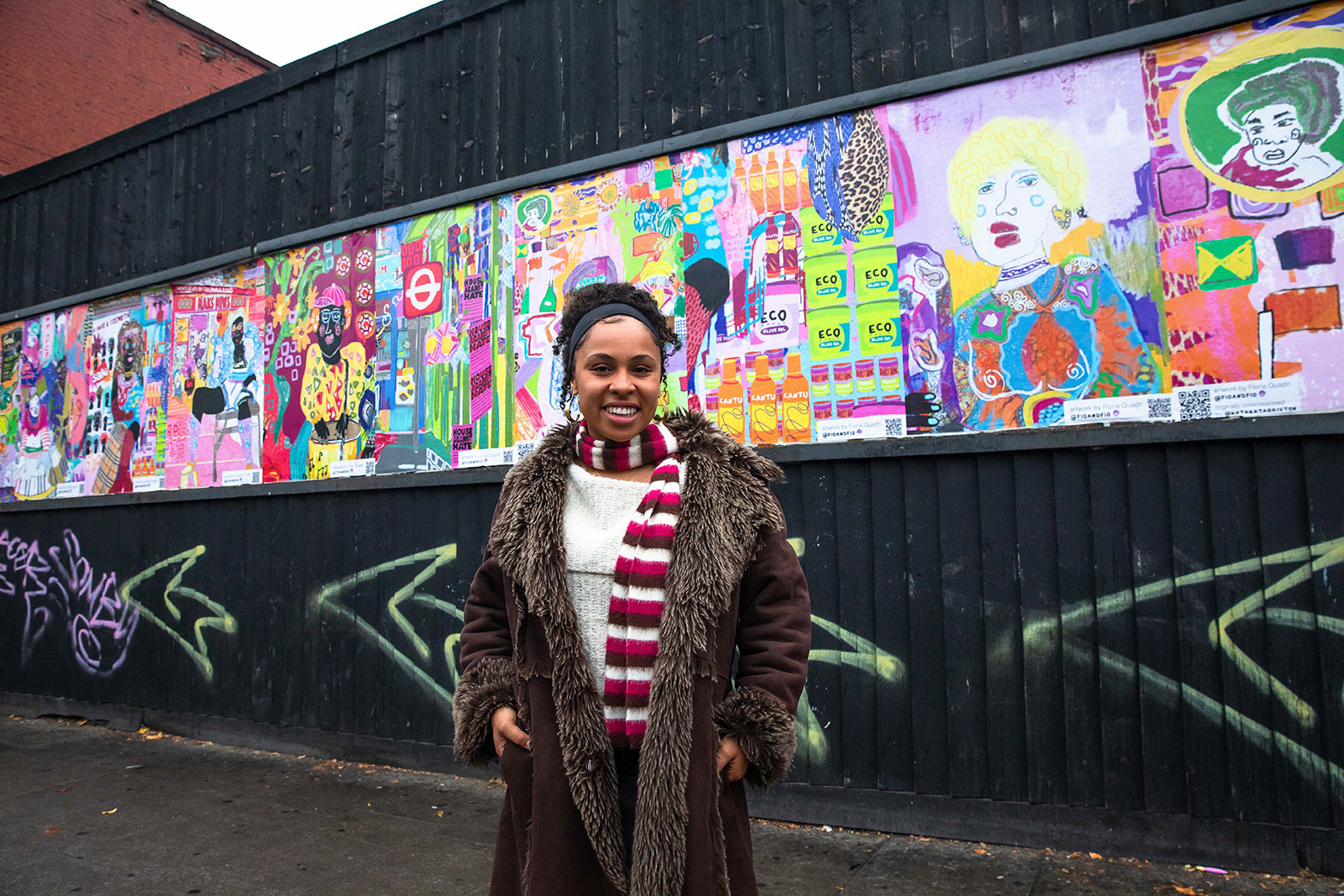
There are stacks of Indomie noodles in Fiona Quadri’s auntie’s living room. Auntie Tola runs a Nigerian food business, so they’ve always just been part of the furniture – stacked up at home, driven around London and, inevitably, appearing in Fiona’s art too. When the Brussels-born artist moved to London at 17, her aunt became an anchor in a new city, reconnecting her with her Nigerian heritage and bringing her along on food deliveries across South and East London. From Deptford Market to the Nigerian shops they supplied, these journeys helped form what she now calls “my London”. Much of her early work began on her auntie’s sofa, but now, almost a decade later, Fiona’s creations can be found lining the streets on billboards across the same city.

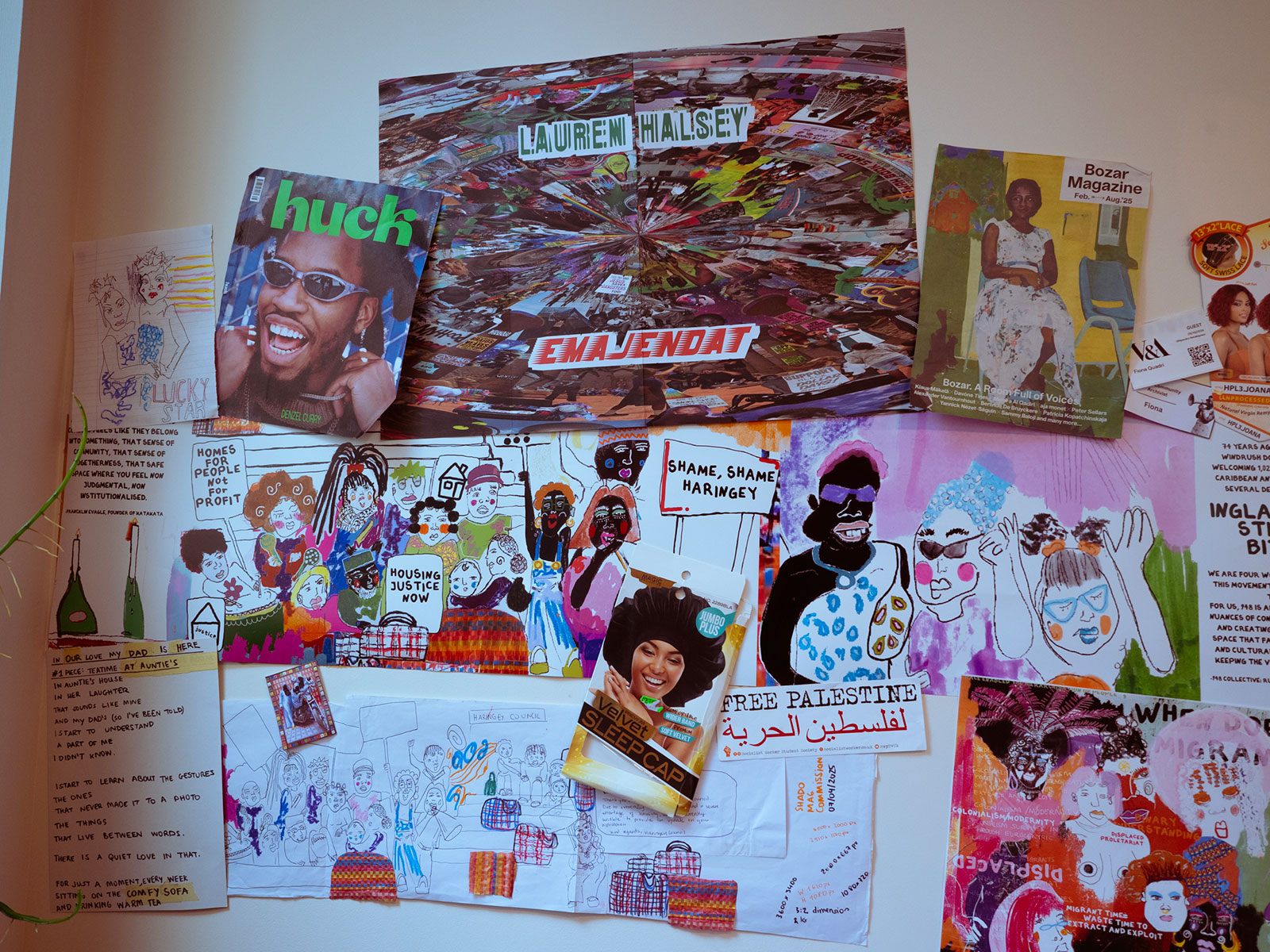
Some of Fiona’s best people-watching happens from the top deck of a London bus. As the city passes below, its people, shopfronts, colours and everyday details become both subject and source material. Her digital camera roll is full, her phone storage chock-a-block; notebooks fill with sketches and observations, while posters, stickers and interesting jars are liable to come home with her. “Everything is research,” she says. Rather than capturing any one scene, Fiona lets these fragments accumulate until, in her own words, they become a “mosaic”.

Drawing on Saidiya Hartman’s Wayward Lives, Beautiful Experiments and its approach to building stories through the fragments left behind, Fiona pieces together visual records of the worlds around her: aunties’ living rooms, friendships, family photographs, fabrics and the objects that gather in a home. Her own identity naturally draws her towards queer Black stories, though she doesn’t necessarily see the work as being defined by those categories. Through them, she is interested in “imagining new worlds within the worlds we’re inhabiting at the moment”.

21.10.26

Words by Elsa Monteith
Fiona is conscious of what happens when these everyday details become symbols. She references The White Pube’s critique of “Diaspora Art”, which questions the fetishisation of objects used to make work look diasporic, something that has made her interrogate her own practice too. But the Indomie packets, shopfronts and domestic interiors in Fiona’s work aren’t details sought out to tell a particular story; they just form part of the worlds she moves through. The same goes for its more overtly political references, with protests, anti-racist organising and conversations with friends and students naturally finding their way in too.

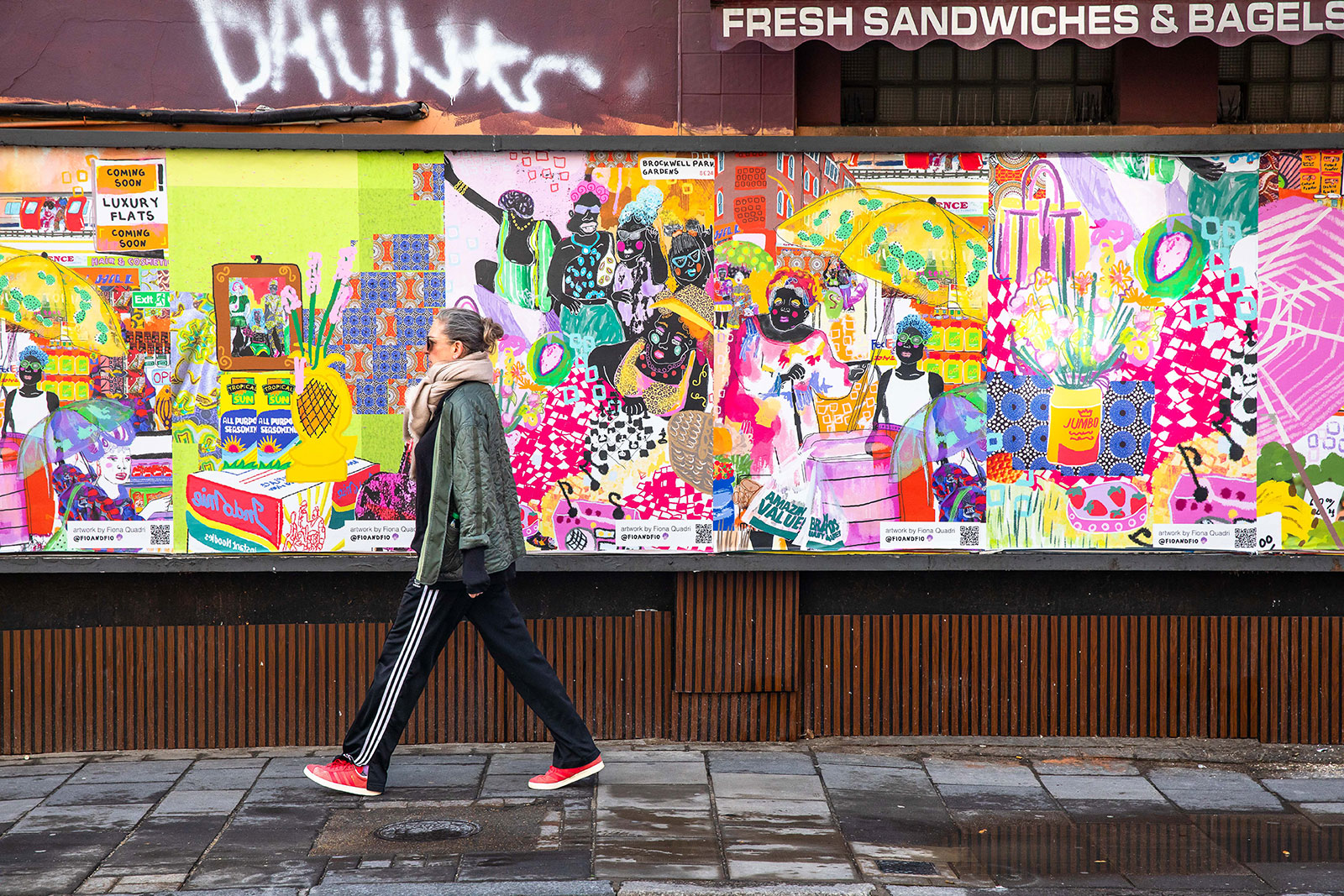
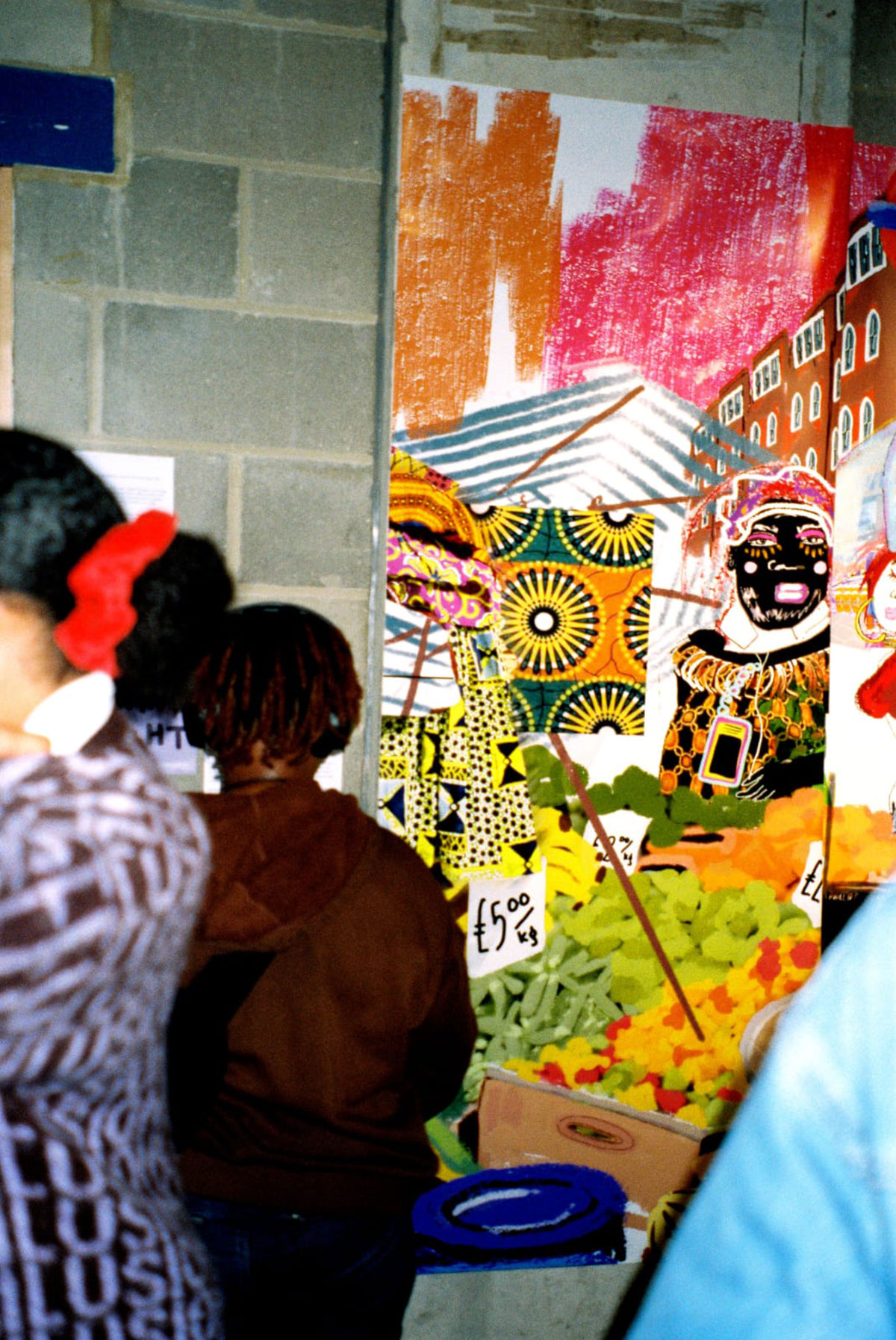
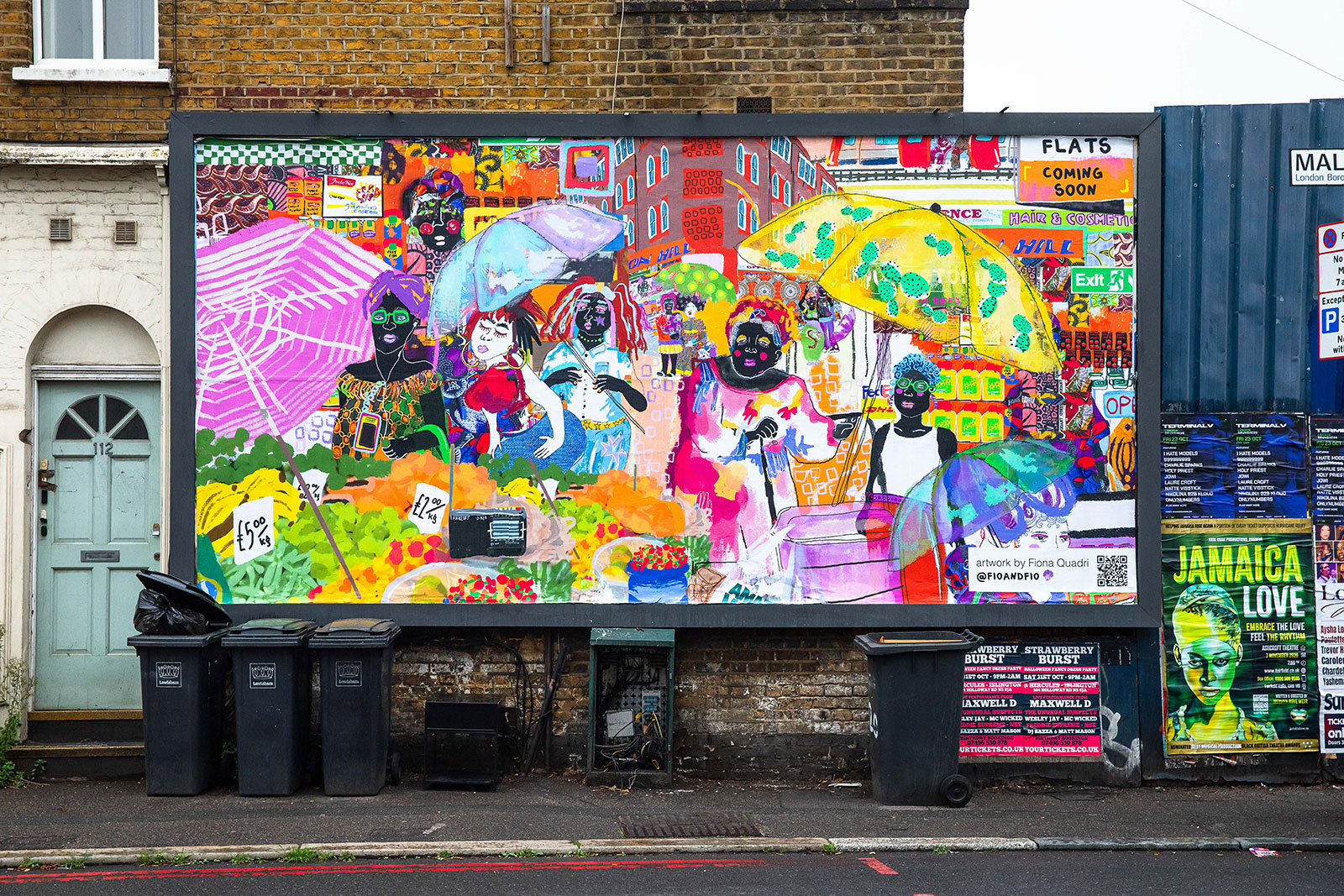
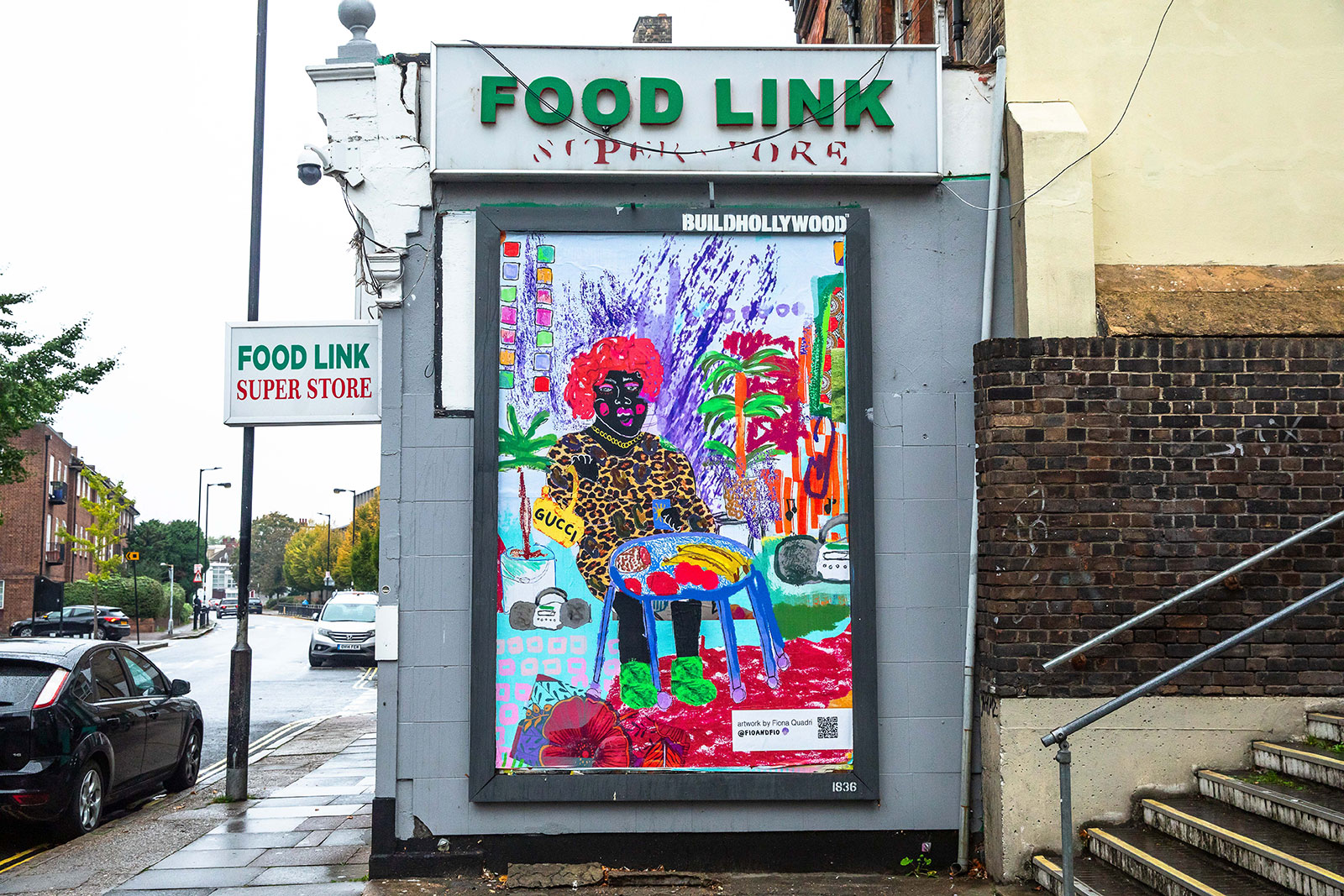
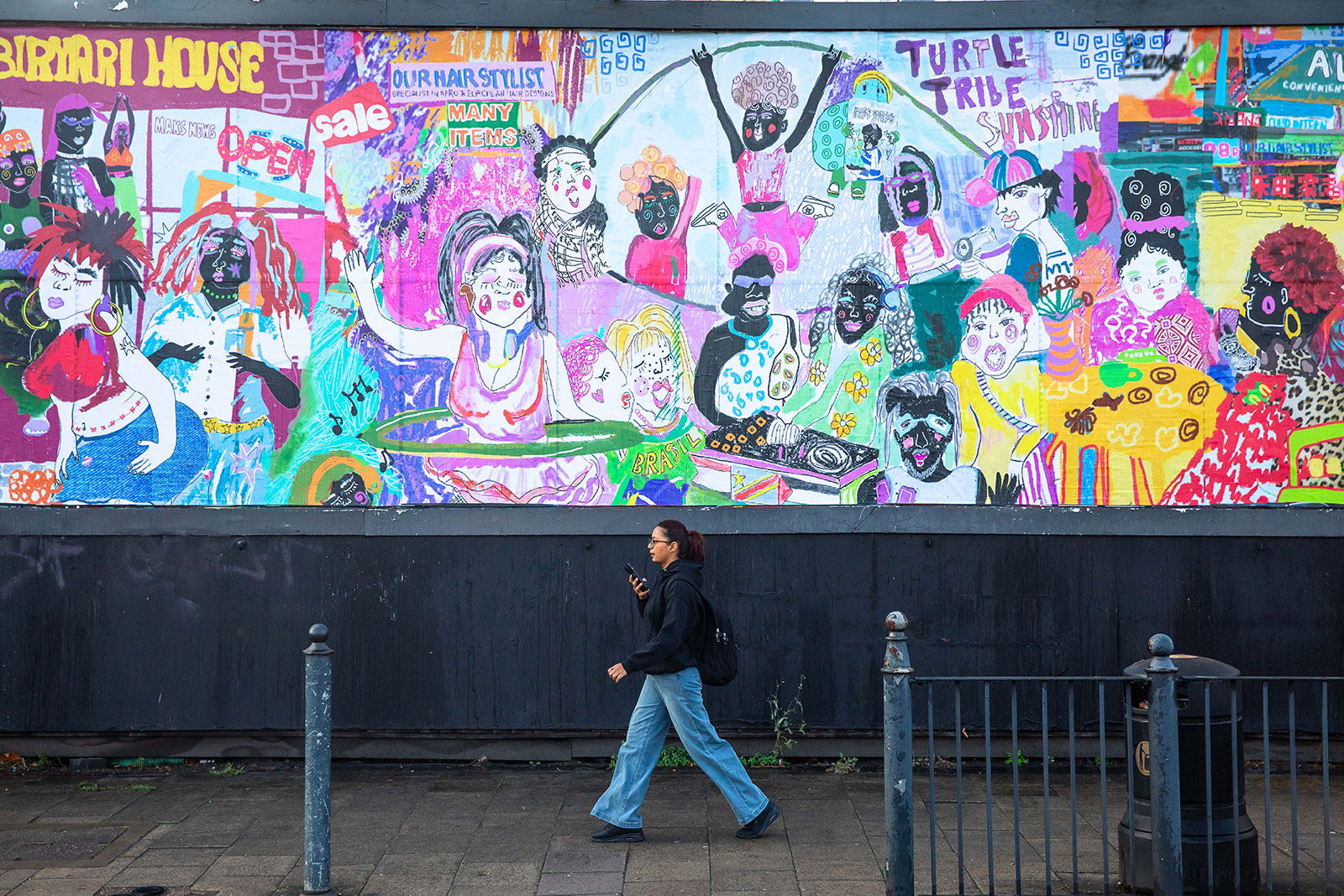
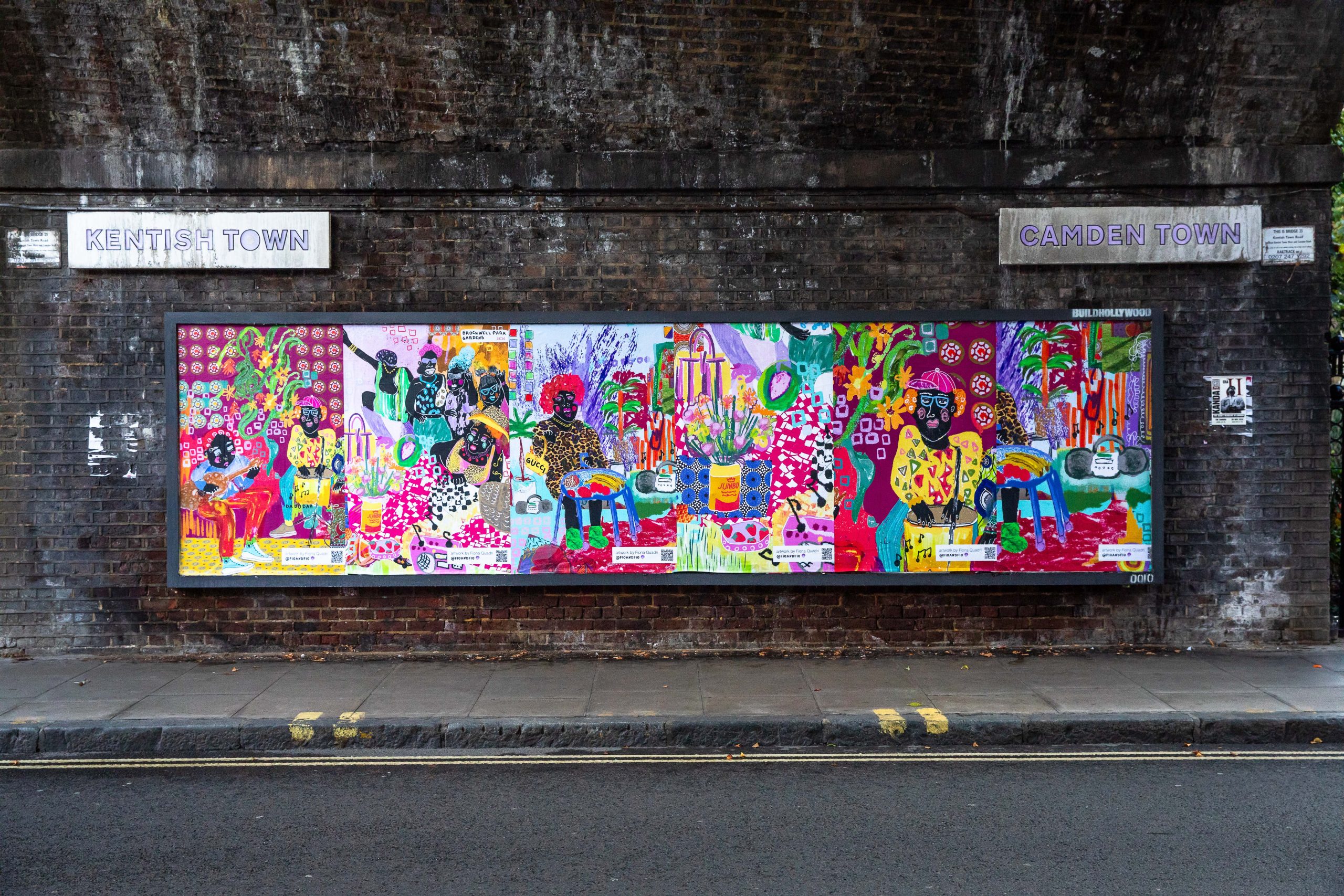
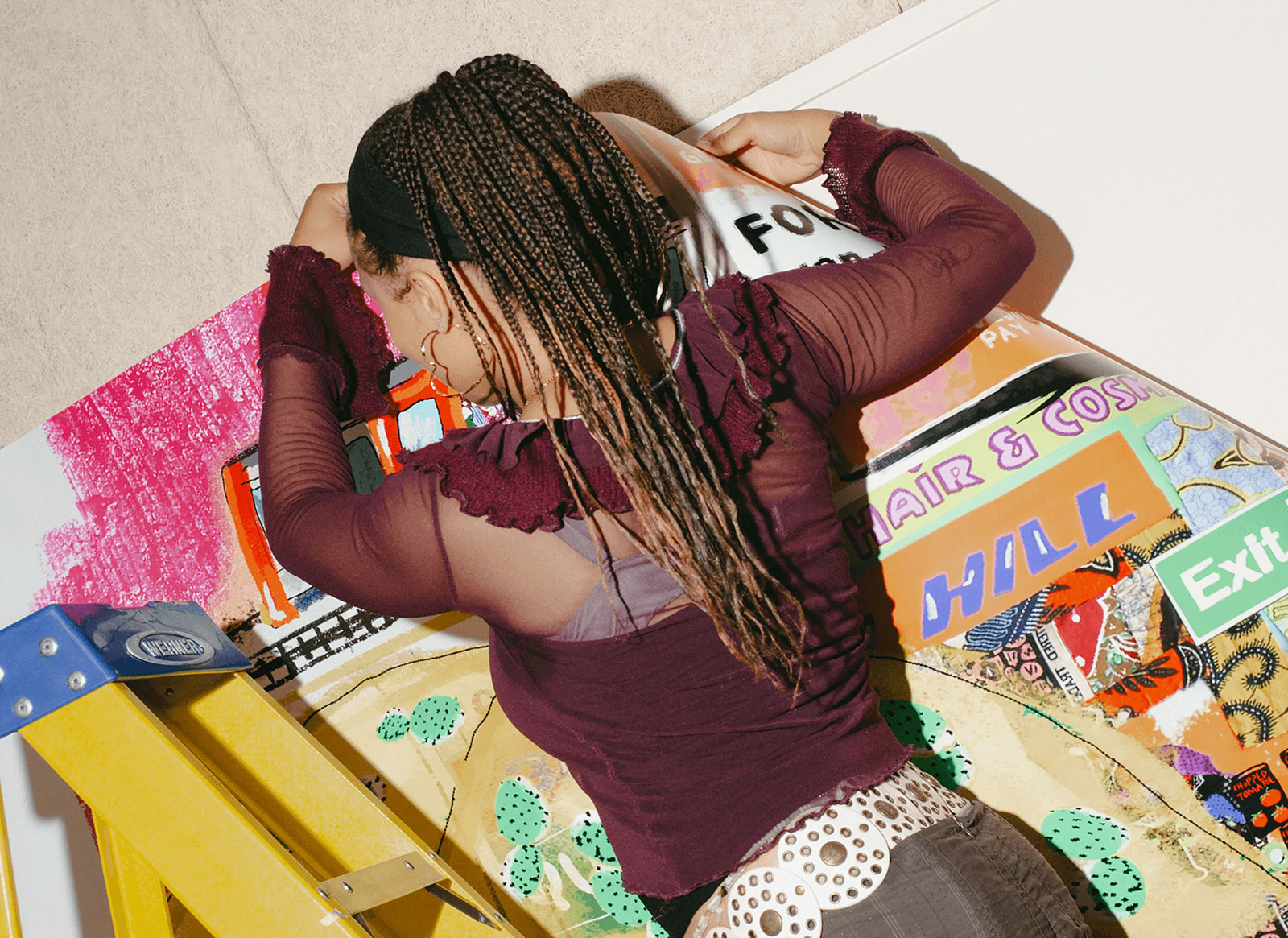
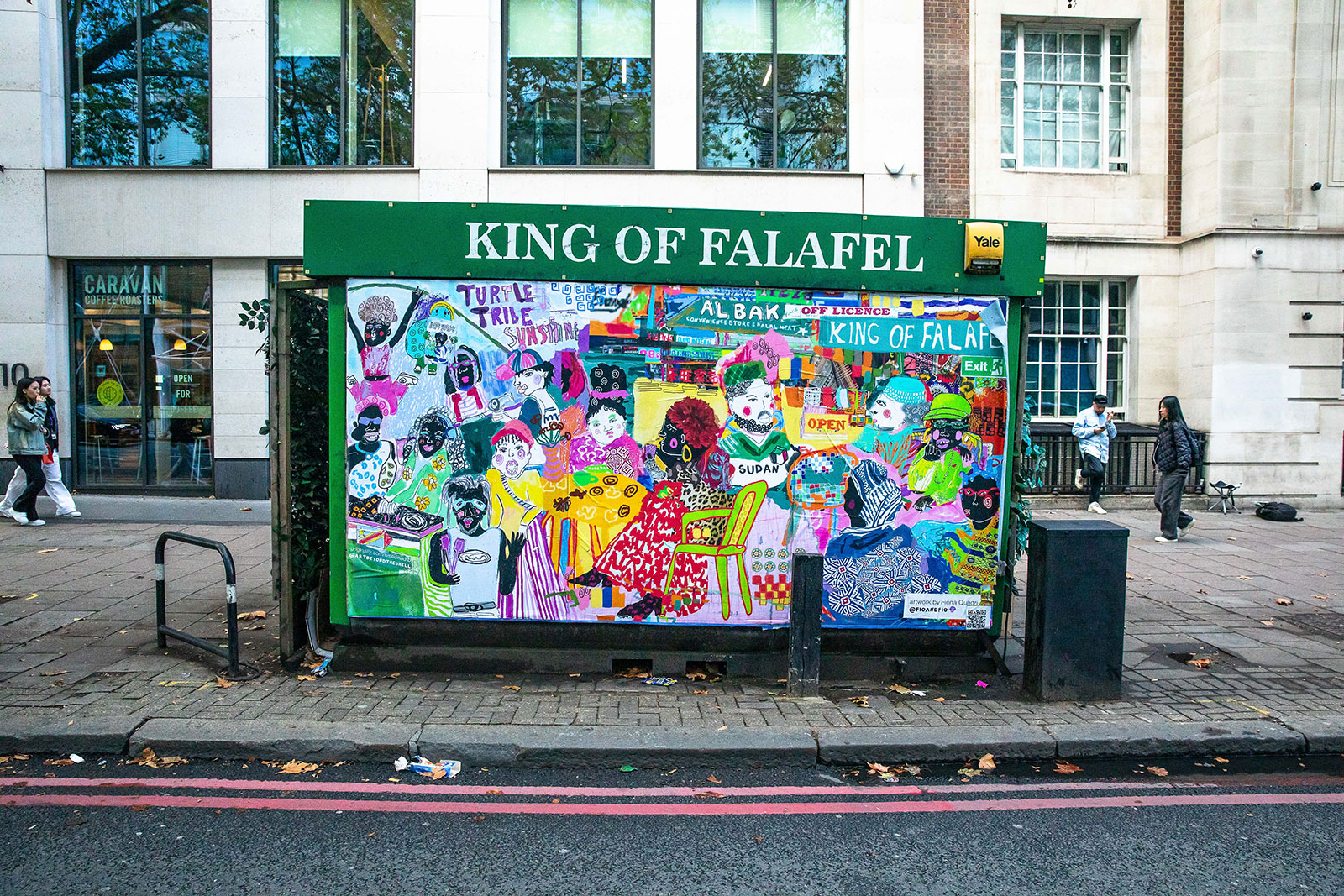
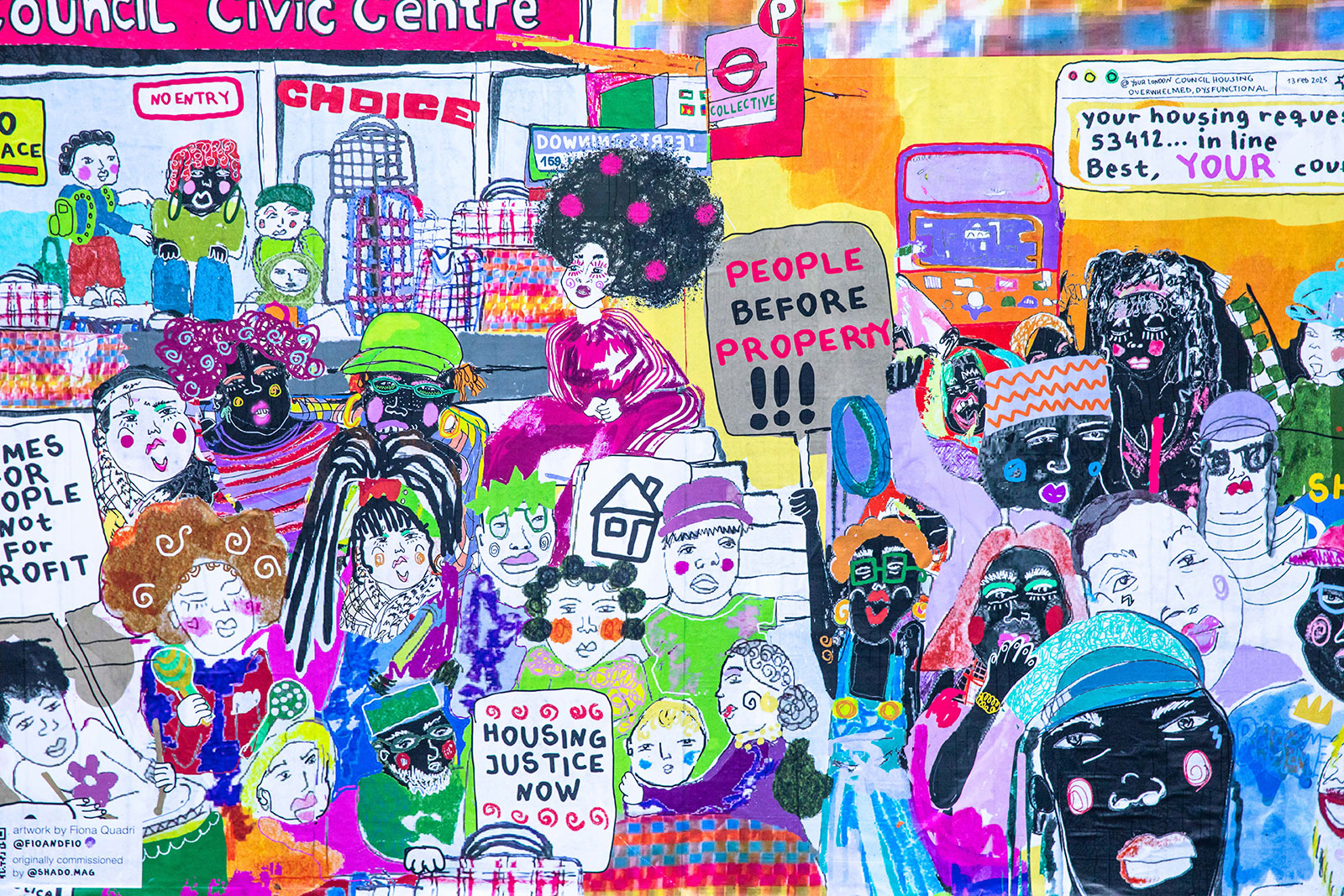
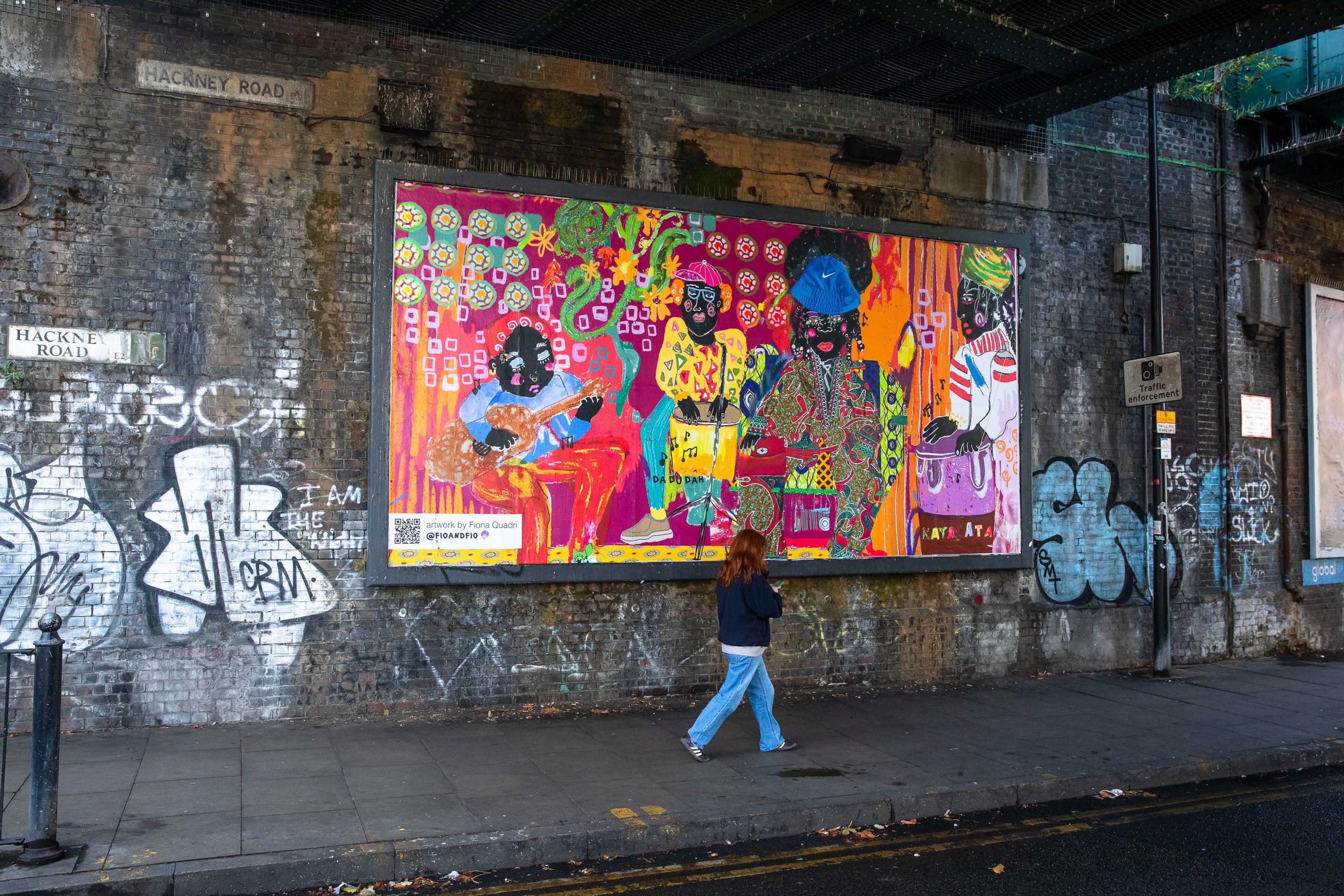
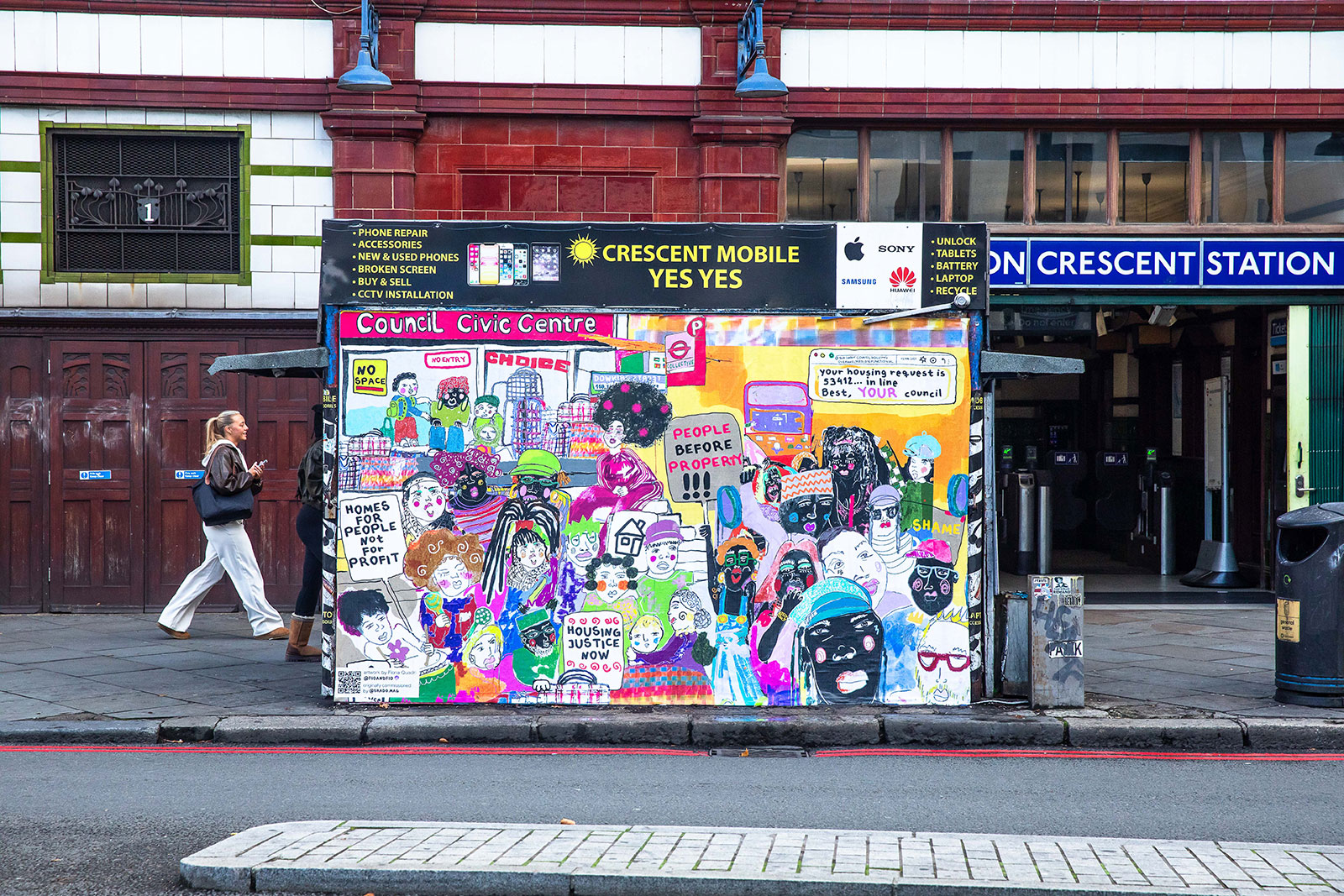
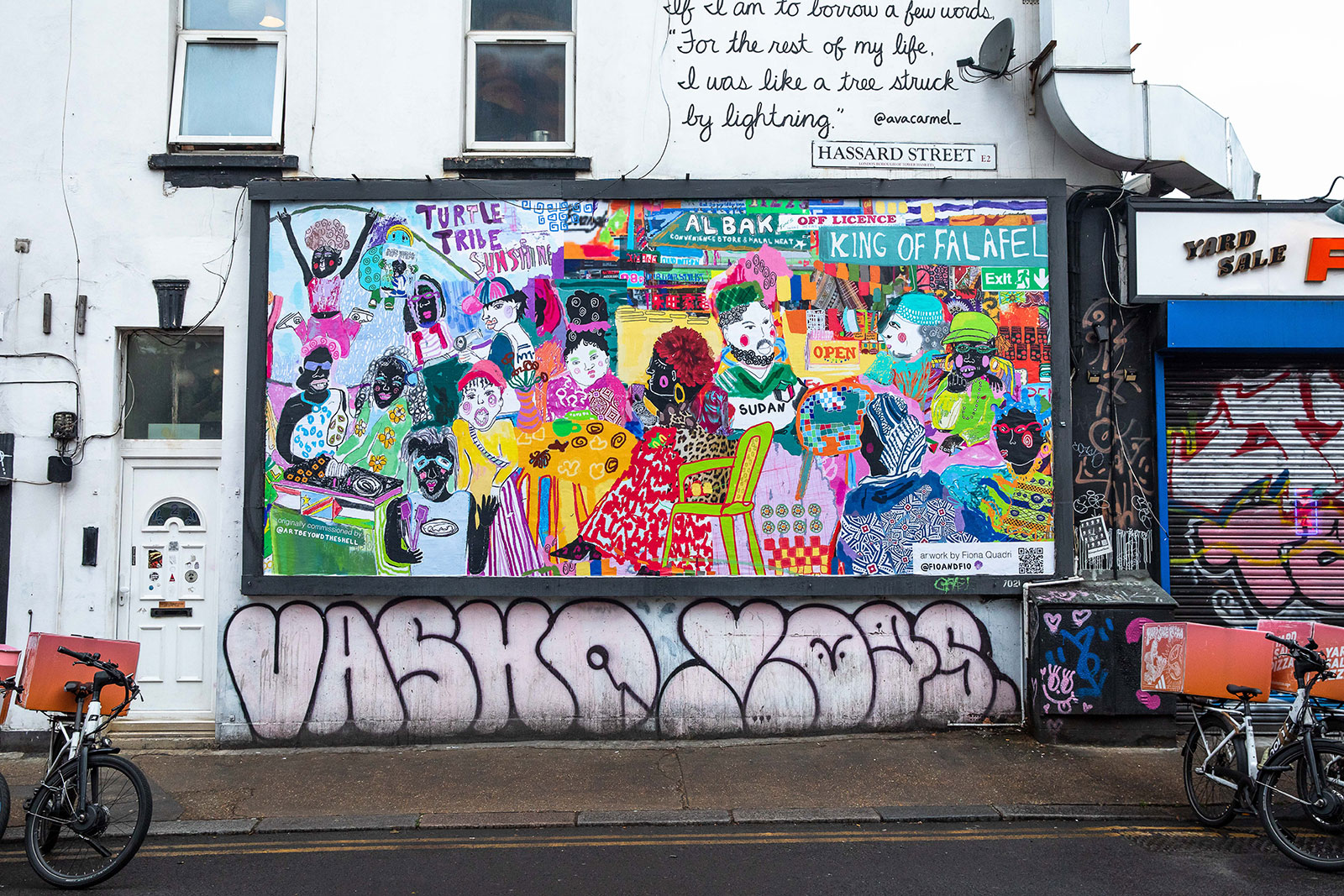
For Abundance of Being, those worlds are taking up space on a much bigger scale. Part of BUILDHOLLYWOOD’s Your Space Or Mine series, the project sees Fiona’s work spread across billboards throughout London in what feels like a “city-wide reintroduction” to her practice. The title unearthed itself in a group chat, when a friend described the overwhelming number of things happening around them as a “beautiful abundance”. The phrase stuck with Fiona, offering an alternative to scarcity and the possibility of a world where “there’s enough for everyone”.

From Auntie Tola’s sofa to billboards across London, Fiona’s archive has travelled a fair distance. But its building blocks remain the same: people, places and everyday details worth paying attention to. Now she’s inviting the rest of the city in too, hoping passers-by might smile, recognise something of their own world and “look at the scene a bit longer”.

You were born in Brussels, have Austro-Nigerian heritage and now call London home. What did your route to becoming an artist look like?

 At 17, I had the opportunity to do a UAL foundation in London which was free for under 19 year olds, and back then we were still in the EU so I had all the little perks (laughs). I did fashion communications, exploring lots of different mediums, styling and illustration, and from there I ended up staying in London, and my studies moved into advertising and branding studies. They were very industry focused and I think because they were so strict, I brought all of that illustration and styling that I did in my foundation back in, and really built my own separate practice. A lot of the work then was formulated specifically around my Auntie Tola, who really helped me settle into London, and now I see her weekly. She’s really been the basis that’s connected me back to my dad and back to my Nigerian heritage. A lot of the art I did was sitting on my aunt’s sofa, that’s really where it emerged.


London feels almost like another character in your work. What do you notice about the city that other people might walk straight past, and which neighbourhoods, people or places have particularly shaped the way you see it?

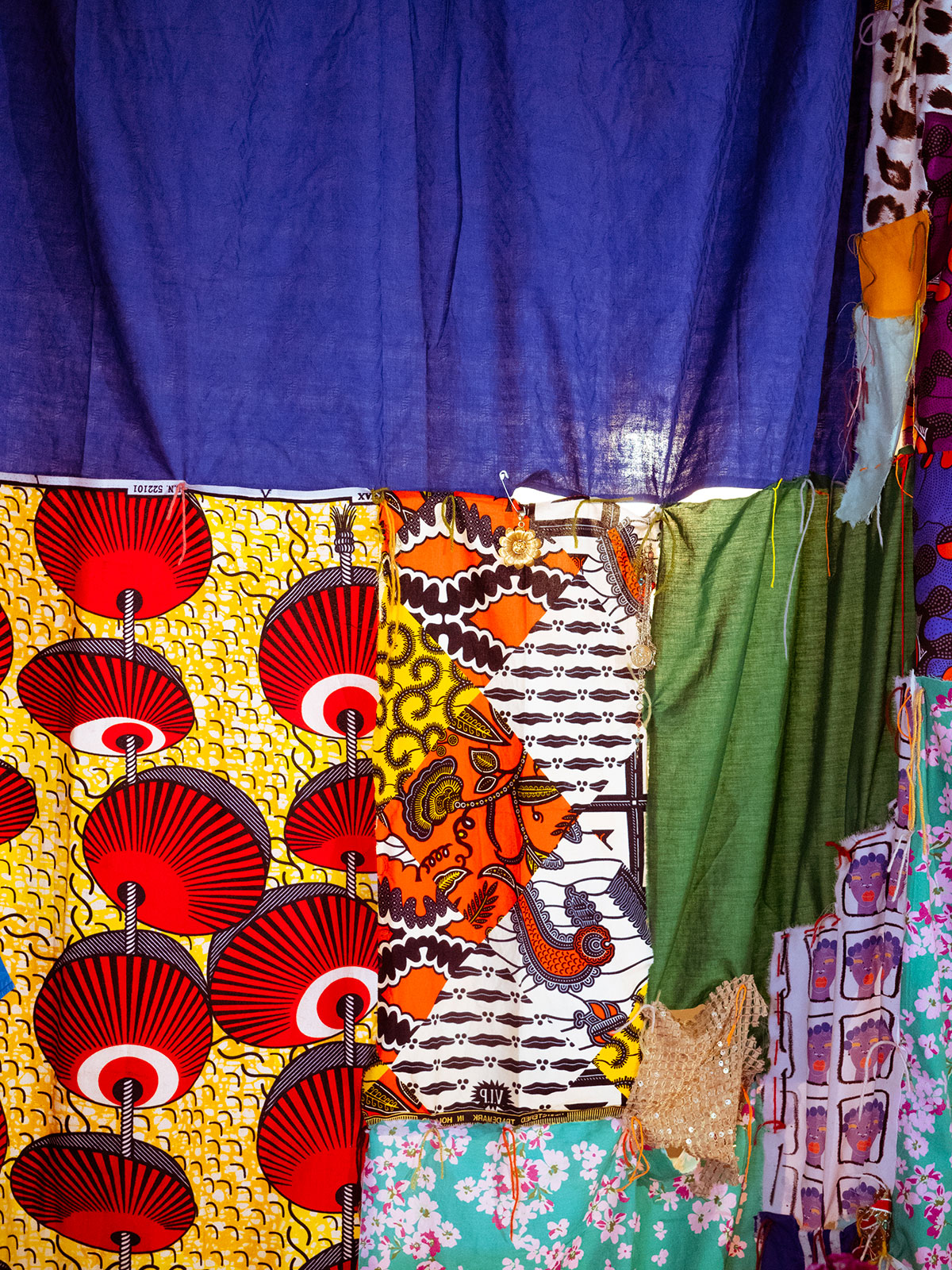
When I came to London, my first anchor point was my aunt. She runs a Nigerian food business, so every time I’d come, she’d tell me at the last minute, “we’re going to drive around”, so a lot of the places that I discovered first off were South and East London. We’d go to Deptford Market and then visit different Nigerian shops and deliver food to them, specifically, Indomie noodles, which often comes up in my work – my aunt just has stacks of Indomie noodles in her living room. Those were the scenes that allowed me to understand what London is, or what my London is, and a lot of it is connected to the Afro-Caribbean diaspora. It’s also based on the connections I’ve made, and the friendships I’ve built were all very much based on these colours, these shops, these sort of fabrics that I’m relating to in my work. There’s so much identity, heritage, and sort of cultural artifacts that come about.

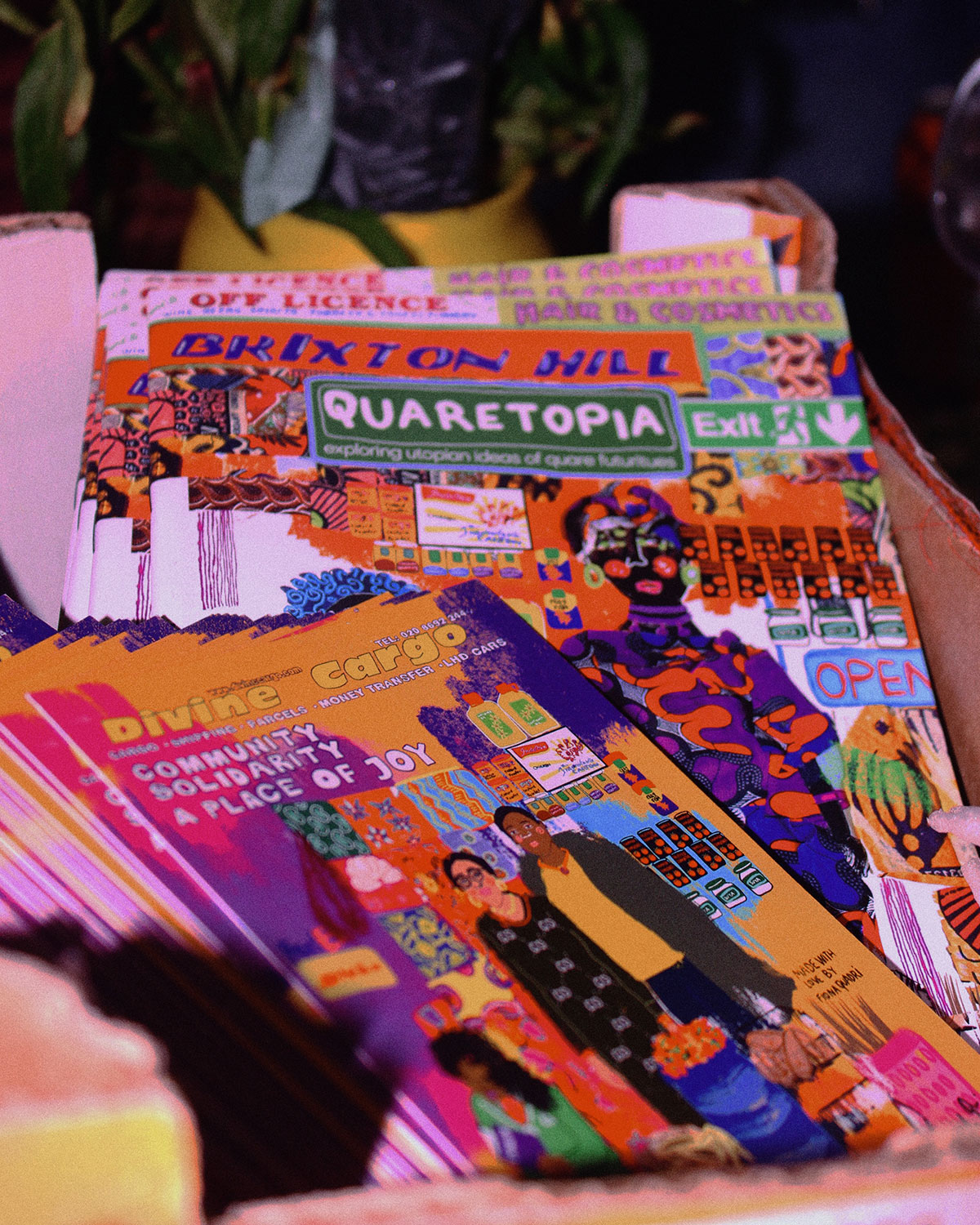
You’ve described yourself as a “visual archivist”, and that idea runs through projects like Quaretopia with SOAS University and Ebony Initiative, as well as your work with The Turtles. What does creating an archive mean to you, and whose lives or experiences are you particularly interested in preserving?

I think a lot of archives are known to be stored away and never looked at again, whereas I really want my artworks to take stories and shape them together in a new way. I also often lean on Saidiya Hartman, and her book Wayward Lives, Beautiful Experiments which explores imaginatory archives through the little bits and bobs that we find, and building new stories through that. I think similarly for my work, creating an archive is telling these stories visually and making people feel really excited about them. Experiencing, let’s say my aunt’s living room, or the Turtles Collective’s summer, their playfulness, their games, their experiences, and really setting that in stone. I do think that because of my own identity, I certainly do gravitate towards queer Black stories, and it doesn’t even have to be focused on this identity category, but ultimately that does naturally build its path in my work. I like imagining new worlds within the worlds we’re inhabiting at the moment.

Your work often starts with collecting conversations, voice notes, receipts, fabrics, photographs, things spotted from the top deck of a bus. What does that research process look like, and how does an everyday encounter eventually become an artwork?

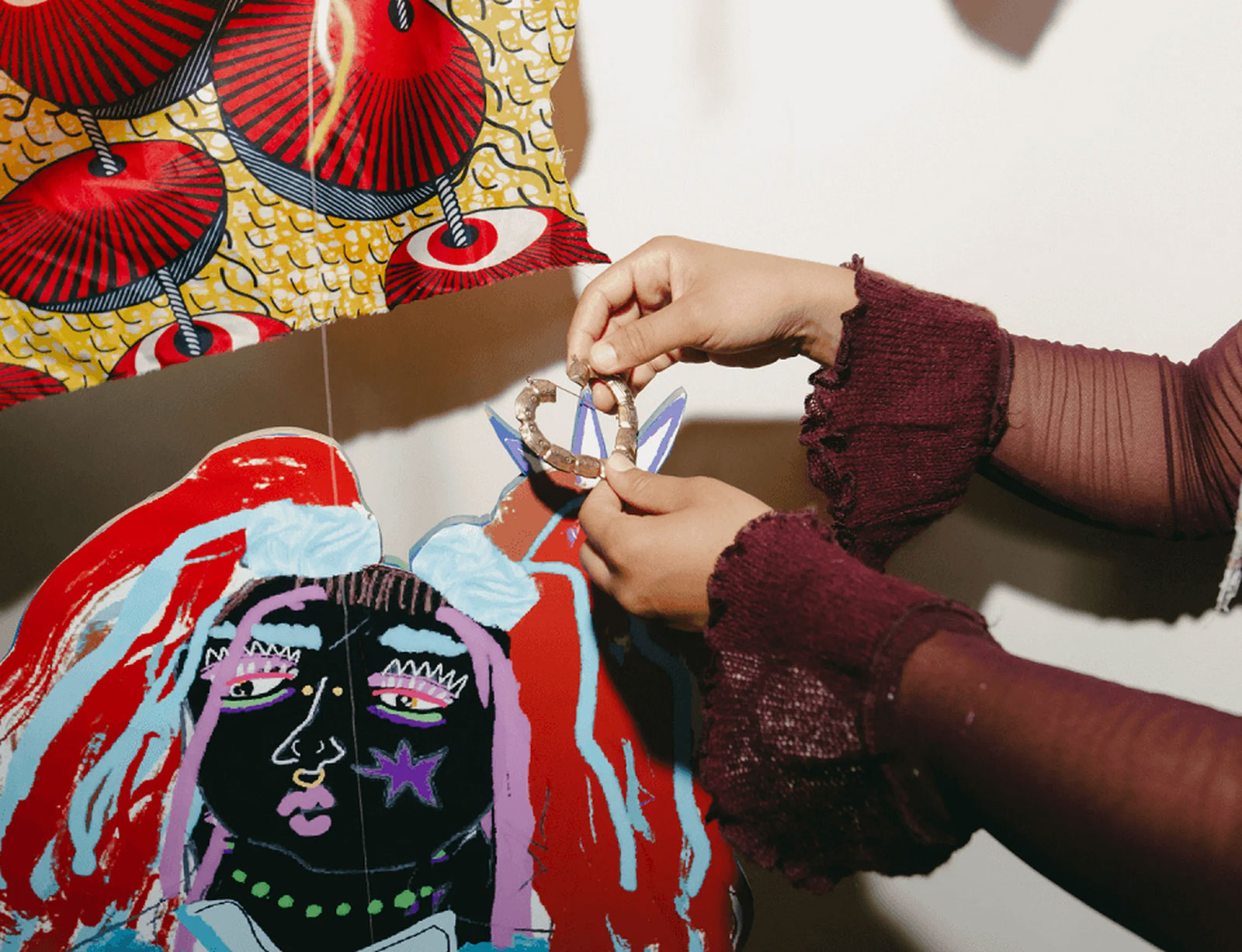
 When I moved to London, my foundation teacher, Selina, was incredible, she would say how research is breathing, eating, doing anything in your day to day, and I’ve really taken that on, it’s really propelled me. I always have my phone or a digital camera, I always take photos. If we go through my camera roll, everything is research. Everything I see, being with my friends, all of that is part of my research. I also love collecting, I love to take things home, I love posters, I love finding interesting stickers or jars on the floor. I think accumulating different objects makes a story interesting.

A long time ago, somebody on Instagram was doing a sort of survey for a project, and you had to voice record yourself and different moments, and that really allowed me to start being a lot more conscious about the sounds around me. I started recording a lot of conversations with my friends, and eventually my phone ran out of storage (laughs), so I did stop the tradition at some point. But I always have a notebook with me, I always take notes and sketches. I think soaking up my environment is what research means to me, and the stories are built from there. It really becomes a mosaic rather than a particular scene.

Places like KataKata, Maks News Shop, Brixton Market and the Black hair shops of Dalston and Lewisham all find their way into this new body of work. What draws you to these everyday community spaces, and what do they reveal about London that you want to hold onto?

I love watching people so much, that’s why I love taking the double-decker bus because I get to sit upstairs and look outside and see people coming in, people going out. I guess it elevates everyday moments, this is where you see where the diaspora are, and the very visible pockets where we see that London is multicultural. I think they stand out a lot in contrast to Brussels, where there would be just one strip or two different streets where you’d see the diaspora come out. I enjoy portraying these places, and they’re also spaces that I also utilise myself. I love the colours and stimulation and the vibrancy that these places offer. KataKata, for example, is a Deaf-led community café in Brixton that became one of those familiar places in my everyday life. I ended up creating an artwork featuring the founder, Francklin Evagle, after we had a long conversation about community, accessibility and creating spaces where people feel like they belong. I think his story naturally became part of this wider picture of the people and places around me.


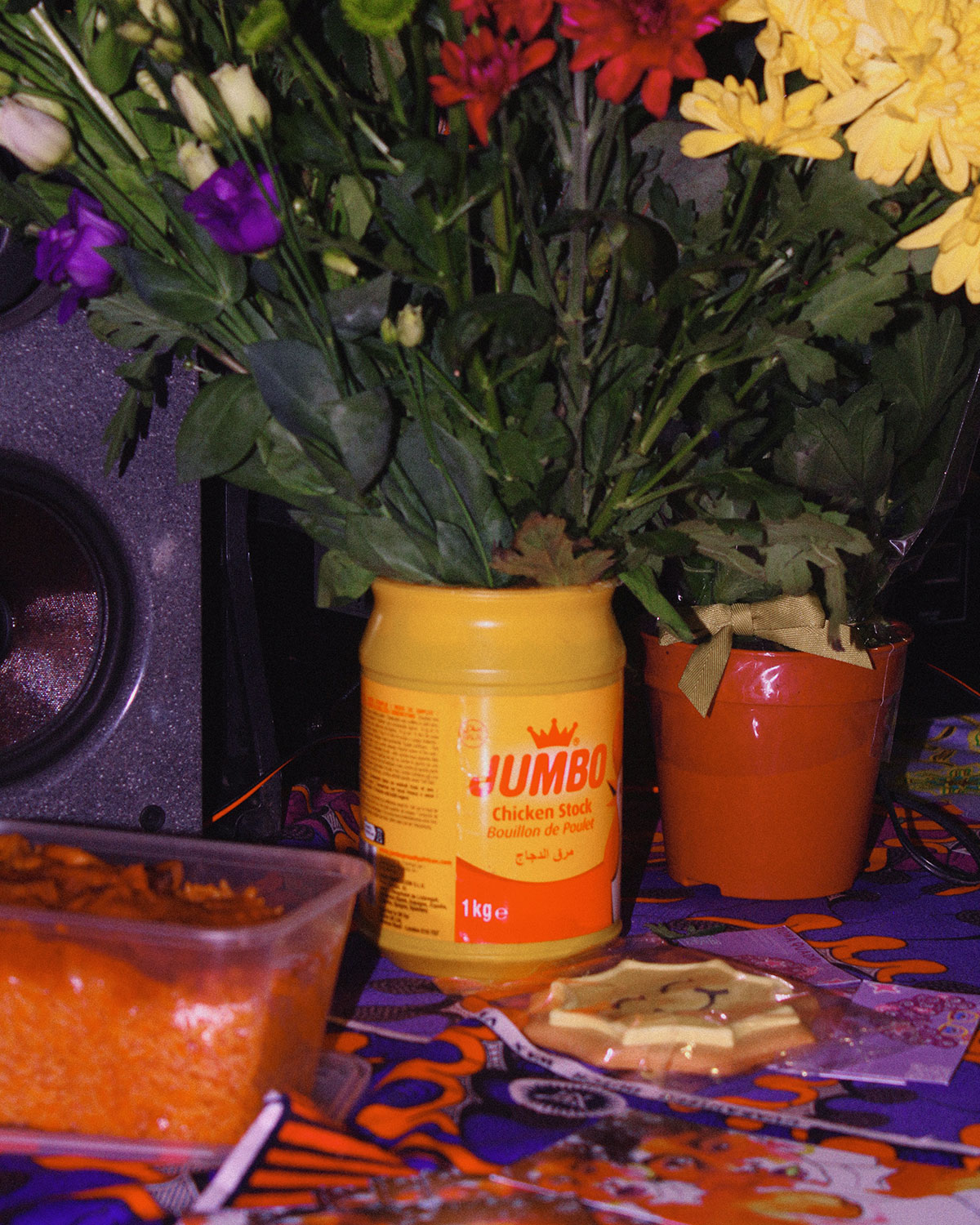
There are some beautifully specific domestic references too – from your auntie using a Jumbo seasoning tin as a vase to the Jamaican living room informed by Michael McMillan’s work and the Black Cultural Archives. Why are objects, interiors and the aesthetics of home such rich territory for you?

I love homes. When living in Brixton, my partner lived with her grandparents, so I’d be at their house a lot. They wouldn’t know that we’re together, but I would be there as a friend. We always say that it’s like a time capsule – they’ve never eaten pizza, they really fostered the Jamaican experiences that they’ve had from back home. The living room walls were orange, the kitchen was green and yellow, and there was always music, Grandad was always smoking weed. The domestic spaces are based on my partner Taimera, her grandparents, as well as my auntie and all those visits. We’d always go to different homes to deliver food, so we’d always sit with different aunties. I think just taking in the different worlds and the different family pictures on the walls, the porcelain fishes. Michael McMillan was also speaking about the different artifacts of the home, and I guess through his lens, coming to these different domestic places made me realise more of what people use and accumulate in their homes.

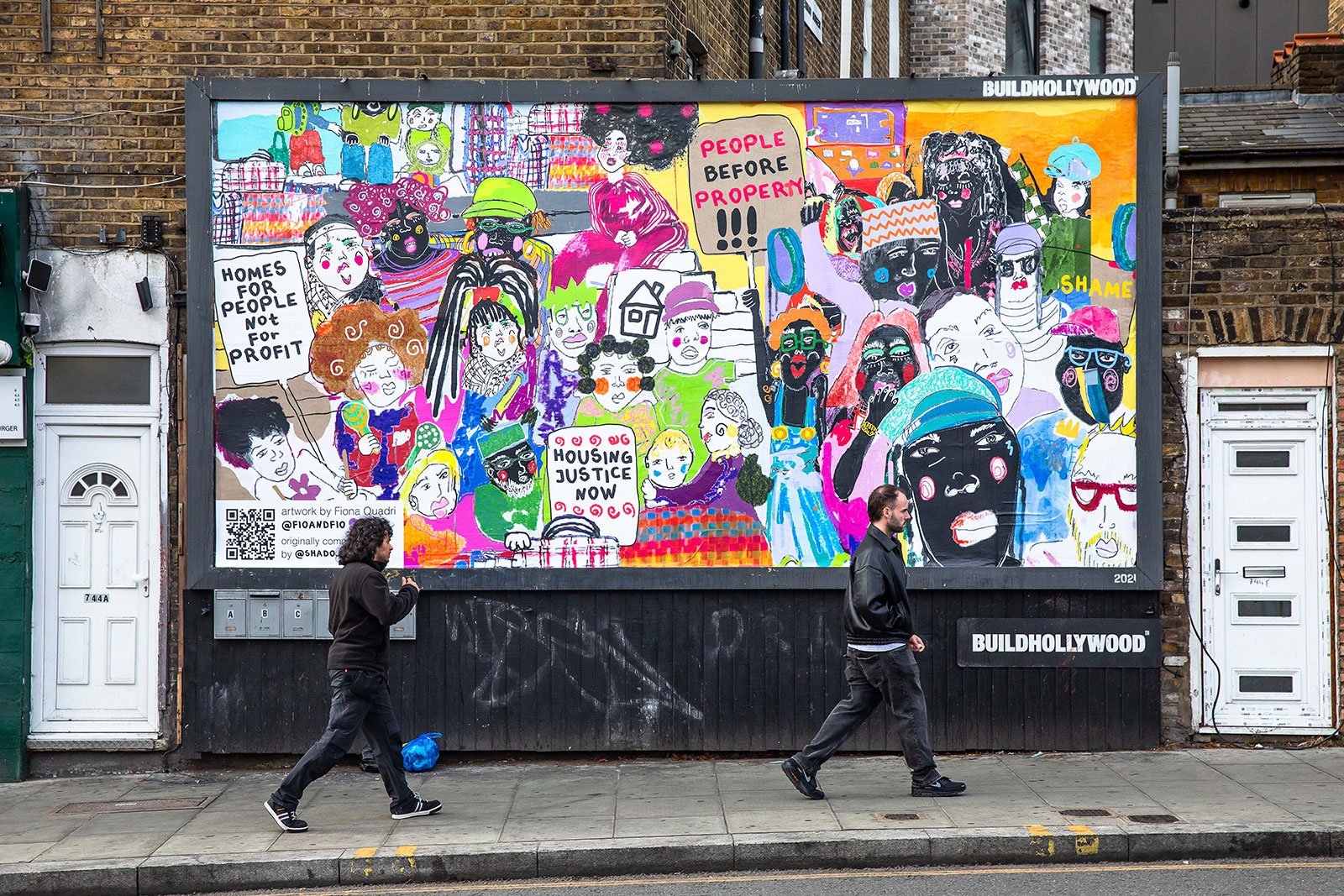
Alongside that celebration, there’s a strong political current running through the work – House Against Hate, the Sudan fundraiser and housing protest, as well as references to gentrification and the cost-of-living crisis. How do activism and collective action feed into your practice, and how do you balance those realities with the joy and humour in your work?

The different political and social justice references are very much based on my day-to-day environment, the people I spend time with, the conversations we have, and the actions we do. House Against Hate was something that me and my friends were going to and discussing, and then my students who were around the age of 17 and 18 were also speaking about it, and it was all over the city. It isn’t just a personal reference, it seems like it moved a lot of young people. I studied post-colonial studies, so I think my general natural incline has often been to do good and to have a purpose with my work beyond aesthetics. I also get to work with Shado magazine who have really allowed me to understand how to visualise political articles or messages, and how I can infuse my work with more politics as well.


You’ve described Abundance of Being as a “city-wide reintroduction” to your work and the beginning of a clearer new chapter. What does the title mean to you?

In a group chat with my friends we were talking about all the different events going on at the same time, and some of us in the chat were getting stressed, like there’s too much! What are we going to do? And then one friend said it’s like a “beautiful abundance”. The word “abundance” really resonates with me because a lot of the time we’re in such a scarcity mindset, with this idea that there’s not enough for everyone that we have to fight and be greedy. I think abundance shows the opposite and offers generosity. I think there’s beauty in the abundance of differences in individuals, whether that is culture, taste in music, different activities, hobbies, lifestyles. It’s a feeling of wanting to shape a world where there’s enough for everyone and we can express ourselves abundantly.

These works come from very particular communities, homes, shops, friendships and corners of London, and now they’re going to take up billboard space across the city. How does it feel to return those stories to public space at that scale – and what do you hope people recognise in them?

My work is often consumed by my friends and family and those who maybe see themselves in the work, or who were inspirations or part of me shaping the work. Now it’s going to be open to the public! It’s always quite daunting, at least for me, to open up work to a bigger audience, but at the same time, I’m really welcoming in people to experience my work through their own lenses. When I showed Khaly from BUILDHOLLYWOOD the work, she was like “I didn’t know Nigerians loved Indomie as well!” (laughs). I’m excited for the different details of the work that might speak to people. When people walk to work and pass the billboard, I hope to help them have a little smile on their face, and maybe be a bit curious to look at the scene a bit longer. I really invite people to just experience it and imagine their own worlds through the different artwork.

Previous article

Marathon Season: Hit The Ground Running

Next article

Partnerships

Inside Birmingham’s Experimental Arts Scene